What will matter most to a child graduating from school in the 2030s?
Strong academic foundations will always matter. But marks alone will not be enough in a world shaped by artificial intelligence, automation, rapidly changing careers, global collaboration and constant access to information.
That is why many parents in Gurugram are beginning to ask a different question when choosing a school:
“Will this school prepare my child only for the next exam—or for the world they will enter after school?”
The answer lies in what happens beyond textbooks. A future-ready education should help students think critically, communicate clearly, understand technology, work with others, manage money, create ideas, take initiative and become increasingly independent.
This guide looks at eight future-ready skills students need today, why they matter, and how parents can identify whether a school is genuinely building them.
Why Future-Ready Skills Matter More Than Ever
The world students are preparing for is changing faster than school systems traditionally have.
Artificial intelligence can already write, calculate, summarise and generate ideas. Employers increasingly value people who can frame problems, judge information, collaborate, communicate, adapt and apply knowledge in situations that do not have one obvious answer.
India’s own school system is moving in this direction. For the 2026–27 session, CBSE’s Skill Education framework includes pathways such as Artificial Intelligence, Information Technology, Introduction to Financial Markets and employability-oriented skill education, alongside skill modules for younger classes.
That shift sends a clear message: the future of education is not “academics versus skills.” It is academics strengthened by skills.
1. Critical Thinking: Learning to Ask Better Questions
In a world where information is available instantly, the ability to remember facts is less valuable than the ability to evaluate them.
Students need to learn how to ask:
- Is this information reliable?
- What evidence supports this claim?
- Is there another explanation?
- What happens if one variable changes?
- Which solution works best, and why?
Critical thinking develops when students investigate real problems, discuss competing ideas and defend their reasoning rather than simply repeating an answer from a textbook.

Parents should look for classrooms where children are encouraged to explain how they reached an answer—not only whether the answer is correct.
2. AI, Robotics and Technology Literacy: Becoming a Creator, Not Just a User
Children are growing up surrounded by technology, but using technology is not the same as understanding it.
A future-ready student should gradually learn how digital systems work, how to use them responsibly and how technology can be used to solve real problems.
That can include:
- Coding and computational thinking
- Robotics
- Artificial intelligence concepts
- 3D printing and prototyping
- Data awareness
- Digital responsibility
- Design thinking

GD Goenka Signature School’s Real World Curriculum™ includes Computer Science, Robotics and Design Thinking as applied learning areas. Its Middle Wing also highlights robotics, 3D printing and design-and-build challenges.
The important question for parents is not simply, “Does the school have a robotics lab?”
Ask instead: “How often do students actually build, test, fail, improve and present something they created?”
3. Communication: Turning Good Ideas Into Influence
A brilliant idea has limited value if a student cannot explain it clearly.
Communication is one of the most transferable skills a child can develop. It affects classroom participation, leadership, university interviews, presentations, teamwork and eventually professional life.
Strong schools create regular opportunities for students to:
- Present projects
- Debate respectfully
- Write persuasively
- Speak in front of groups
- Listen actively
- Adapt their message to different audiences
Programmes such as public speaking and Model United Nations are particularly useful because students must research a position, organise their thoughts and respond in real time.
At GD Goenka Signature School, MUN and debate feature in the Middle Wing, while the Real World Curriculum includes public speaking and project presentations.
4. Collaboration: Learning How to Work With Different People
Many of the biggest problems students will face as adults cannot be solved alone.
Whether they enter science, business, medicine, technology, design or public service, they will need to work with people who think differently from them.
Collaboration teaches children how to:
- Share responsibility
- Listen to other viewpoints
- Resolve disagreements
- Lead when required
- Support another person’s strengths
- Deliver work as part of a team
This is why good project-based learning matters. A strong group project is not simply four students dividing a poster into four sections. It requires them to make decisions together, solve problems and produce one coherent outcome.
5. Financial Literacy: Understanding Money Before Adulthood
Students may leave school knowing algebra, chemistry and history but still feel uncertain about budgeting, saving, spending, investment or financial decision-making.
That gap is increasingly difficult to justify.
Children are exposed to digital payments, online shopping, subscriptions, advertising and financial choices earlier than previous generations.
Financial literacy can begin with age-appropriate ideas such as:
- Needs versus wants
- Budgeting
- Saving for a goal
- Interest and compounding
- Risk and reward
- Responsible digital spending
- Basic investing concepts
CBSE’s current skill framework includes Introduction to Financial Markets among its skill-subject options, reflecting the growing importance of financial awareness.
GD Goenka Signature School’s Real World Curriculum lists Financial Literacy within Mathematics, while its Senior Wing Commerce Studio includes financial literacy, business studies and entrepreneurship.
6. Entrepreneurship: Learning to Turn Problems Into Possibilities
Entrepreneurship education is not about telling every child to start a company.
It is about teaching a mindset:
Notice a problem. Understand the user. Design a solution. Test it. Learn from feedback. Improve it.
That process develops initiative, resilience, creativity, financial awareness and communication.
One of the Real World Curriculum learning stories at GD Goenka Signature School is an Entrepreneurship Sprint in which senior students develop a product, build a minimum viable version, conduct a customer pilot and pitch their idea.
Experiences like this can turn concepts from economics, mathematics, communication and design into something students actually have to use.
7. Creativity: The Skill That Connects Everything Else
Creativity is sometimes treated as something that belongs only to art class.
In reality, creativity is the ability to produce a useful new idea—and that matters in almost every field.
A scientist needs creativity to design an experiment. An engineer needs it to solve a constraint. An entrepreneur needs it to see an opportunity. A writer, architect, teacher or programmer needs it every day.

Arts, music, theatre, pottery and maker activities help children become comfortable with experimentation and iteration.
They also teach an important lesson that exams rarely teach: sometimes there is more than one good answer.
8. Self-Management: The Ability to Learn Without Being Chased
Perhaps the most underrated future-ready skill is independence.
As students move toward university and adulthood, no teacher or parent can organise every deadline, remind them of every task or solve every difficulty.
Students need to learn how to:
- Plan their time
- Set priorities
- Study independently
- Ask for help early
- Reflect on mistakes
- Manage pressure
- Take responsibility for outcomes
GD Goenka Signature School’s Real World Curriculum identifies Independent Study as one of its three core pillars, alongside Deep Concept Learning and Interdisciplinary Projects.
That combination is significant: the goal is not merely to give students more work, but to help them become increasingly capable of directing their own learning.
What Does Future-Ready Learning Look Like in a Real School Day?
Imagine a student beginning the day with a mathematics lesson, then working with classmates on a sustainable-city project.
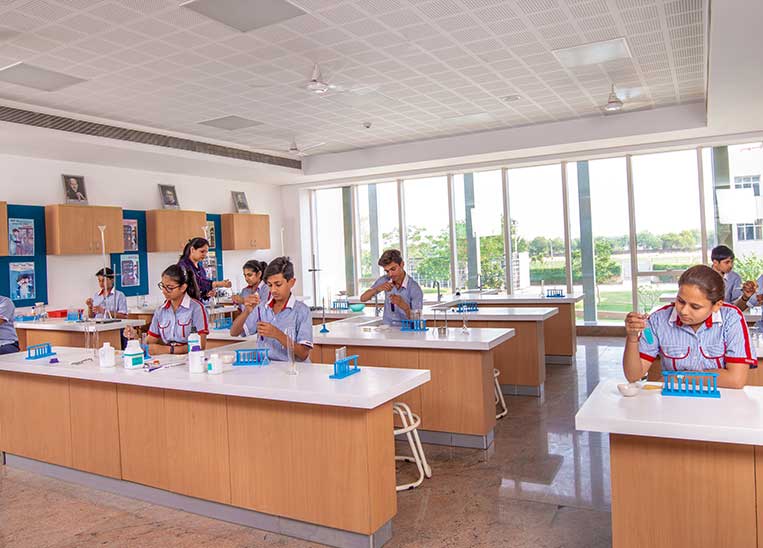
Later, the student uses a science concept to solve an energy problem, tests an idea in a lab, prepares a presentation, participates in a debate and finishes the day in sport, music, robotics or art.

That is a very different model from learning subjects in isolation and forgetting them after an examination.
It helps students understand that mathematics, science, language, technology, economics, design and communication are not separate worlds. Real problems use several of them at once.
How Parents Can Tell Whether “Future-Ready” Is Real or Just Marketing
The phrase future-ready is easy to put on a brochure.
Parents should look for evidence.
During a school visit, ask these questions:
- Can you show me projects students have actually completed?
- How often do students use robotics, science or maker facilities?
- Where does financial literacy appear in the curriculum?
- Do students present and defend their work?
- How are communication and collaboration assessed?
- Are there entrepreneurship or design challenges?
- How does the school teach responsible use of AI and technology?
- How much independent study is expected at different ages?
- Can students participate in MUN, debate, arts and leadership programmes?
The strongest schools should be able to answer with examples, not slogans.
How GD Goenka Signature School Approaches Future-Ready Education
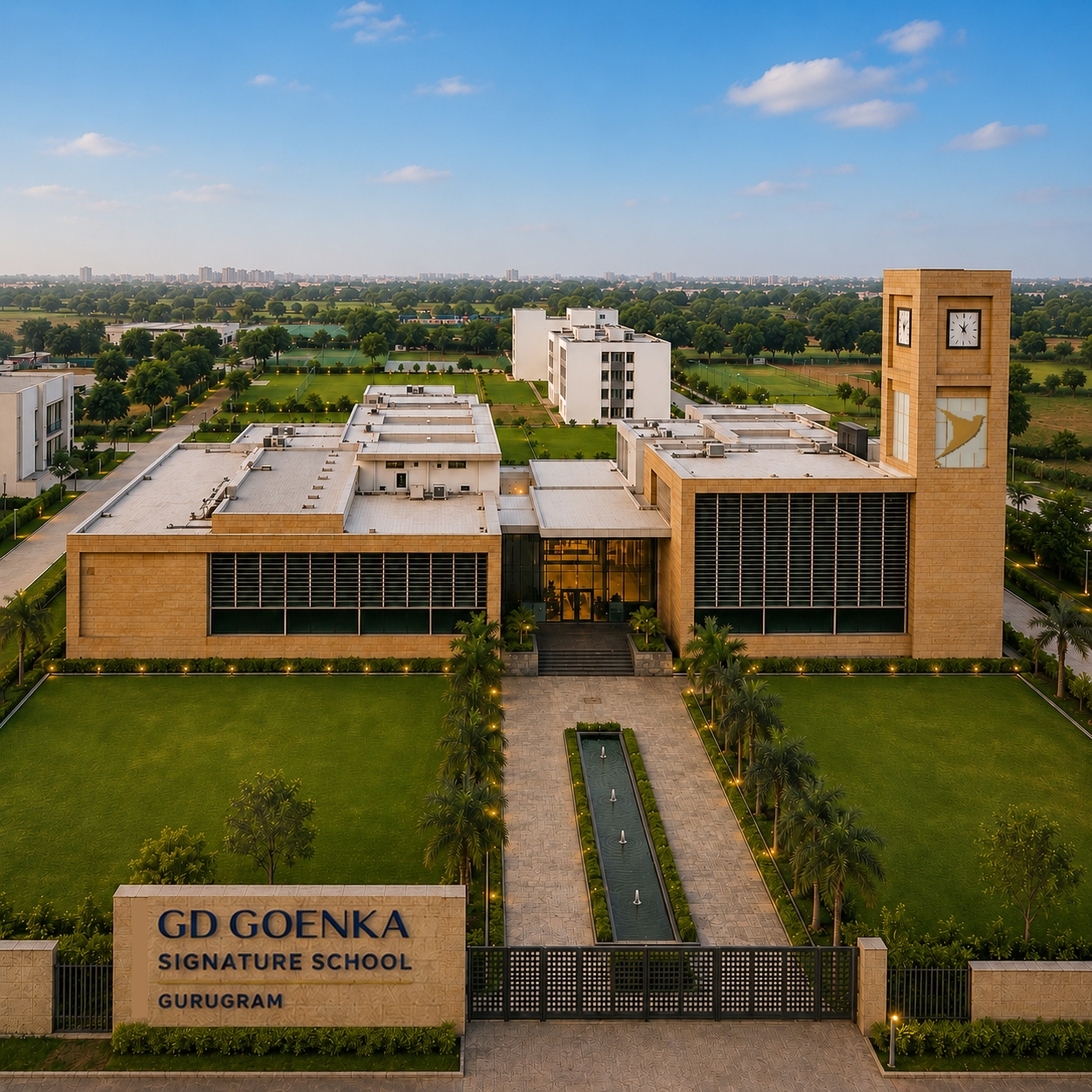
GD Goenka Signature School is a CBSE-affiliated school in Gurugram, but its academic positioning goes beyond board preparation.
Its Real World Curriculum™ is built around three pillars:
- Deep Concept Learning — beginning with real-world questions
- Interdisciplinary Projects — connecting subjects around meaningful challenges
- Independent Study — giving students structured opportunities for self-directed enquiry
The programme also includes Financial Literacy, Public Speaking, Computer Science, Robotics, Design Thinking and Entrepreneurship.
In the Middle Wing, students are exposed to robotics, 3D printing, MUN, debate and interdisciplinary projects. In the Senior Wing, the school adds career mentoring, internships, entrepreneurship and stream-specific pathways across Science, Commerce and Humanities.
The result is a useful model for parents to evaluate: not whether a school has one “future skills” class, but whether those skills are woven through academic and student life.
The Bigger Goal: A Student Who Can Handle an Unknown Future
No school can predict exactly which careers will exist fifteen years from now.
That is precisely why future-ready education matters.
The goal is not to train a child for one specific job. It is to develop a learner who can enter an unfamiliar situation, understand it, ask useful questions, learn what is needed and respond with confidence.
A student with strong fundamentals plus critical thinking, technology literacy, communication, collaboration, financial awareness, creativity, initiative and self-management has something more durable than preparation for one exam.
They have the ability to keep learning.
Conclusion
For parents choosing a school in Gurugram, the conversation is changing.
Academic results still matter. CBSE preparation still matters. But the strongest education should also prepare children for decisions, problems and opportunities that cannot be predicted today.
When visiting schools, look beyond the smart classroom and the glossy lab.
Ask what students do with those resources.
Ask whether they build, debate, present, design, collaborate, manage money, lead, create and reflect.
Because the most future-ready child may not be the one who memorises the most information.
It may be the one who knows what to do when the answer is not already written in the book.
Frequently Asked Questions
What is future-ready education?
Future-ready education combines strong academic foundations with transferable skills such as critical thinking, communication, collaboration, technology literacy, creativity, financial awareness and independent learning.
Why are AI and robotics important for school students?
They help students understand how modern technology works while developing logic, design thinking, experimentation and problem-solving. The value is greatest when students build and apply rather than simply watch demonstrations.
Does CBSE include skill education?
Yes. CBSE’s 2026–27 Skill Education framework includes skill learning for Classes VI–VIII and subjects such as Artificial Intelligence, Information Technology and Introduction to Financial Markets at secondary levels.
Why should children learn financial literacy at school?
Financial literacy helps students understand saving, spending, budgeting, risk and responsible decision-making before they begin managing money independently.
How can parents identify a genuinely future-ready school?
Ask to see real student projects and find out how frequently students use labs and maker spaces, present work, collaborate, study independently, learn financial concepts and participate in technology, entrepreneurship, debate and creative programmes.
Does GD Goenka Signature School teach robotics and entrepreneurship?
Yes. The school’s Real World Curriculum lists Robotics, Design Thinking and Entrepreneurship among its applied learning areas, and its Middle and Senior Wings include related project, leadership and career-development opportunities.